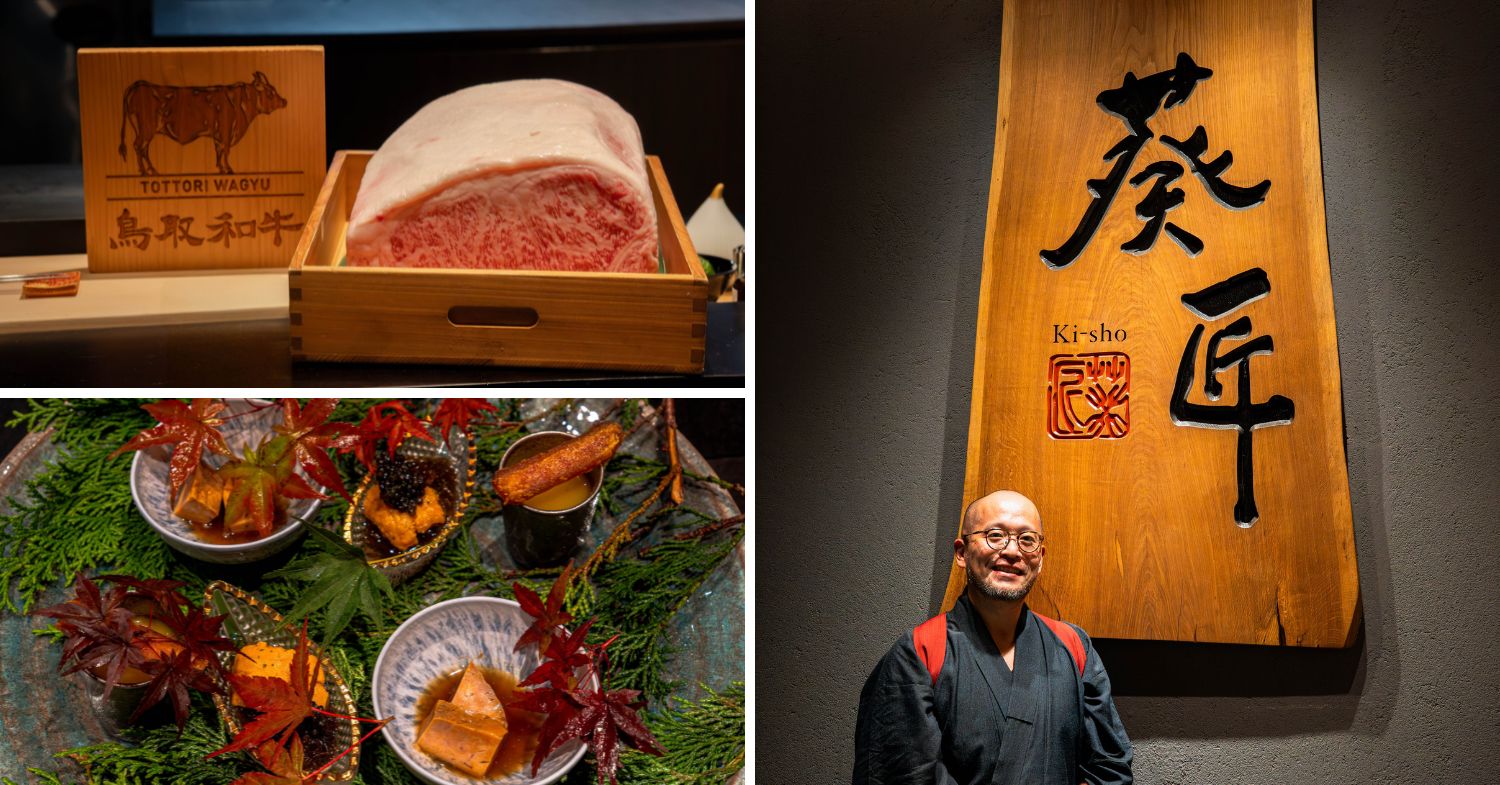
Ki-Sho at Scotts Road brings an exquisite omakase with Tottori Wagyu, Kuro Awabi and more

Japanese omakase restaurant Ki-Sho (葵匠) is no stranger to the scene; first opened in 2012, it has seen multiple renewals over the years, introducing renowned chefs that showcase the pinnacle of mastery of Japanese cuisine. This time, the bespoke restaurant has brought in Chef Taro Takayama at the helm, along with his kappo-style tasting menu that highlights the bounty of nature and the ever-changing seasons.

Chef Takayama hails from Wakayama, Japan, in the heart of the Kansai region where the more personal kappo-style omakase originated from. Kappo, which means “to cut and cook”, features a multi-course meal of seasonal ingredients decided entirely by the chef, and guests can experience an intimate, up-close performance of the virtuoso at work as their dishes are prepared before their very eyes.
Beginning his career at prestigious three-star Michelin restaurants in Osaka, Chef Takayama was appointed Master Chef at the Japanese ambassador’s residence in 2013, serving various dignitaries and celebrities such as Crown Prince Naruhito and then Prime Minister Shinzo Abe. Some might recognise his name from his eponymous restaurant Takayama which was founded in 2017 at Shenton Way, and he brings to Ki-Sho some signature favourites from his previous escapades.

As a prelude to the night, we were served a shot of concentrated Dashi to warm up the stomach. This was a palate cleanser made from konbu stock, and served as a no-frills appetiser that showcased the chef’s focus on purity and clarity in his style.
Pictured above is the first course, the Monaka. Chef Takayama describes this as a whimsical nod to the peanuts typically served as an appetiser in Chinese restaurants. It features a wafer shell in the shape of a peanut that houses foie gras mousse, enhanced with sake and watermelon.

The wafer shell was crisp, an antithesis to the creamy mousse within. It was rather surprising that the foie gras was not strong or cloying, instead taking a rather subtle undercurrent that was accentuated by the sharp sake and watermelon. This created a pleasant bite that showcased Chef Takayama’s style; subtlety and delicately crafted flavours come together harmoniously. However, I did not enjoy the astringent, excessively earthy taste of the red beans that accompanied the Monaka.

The next course, Kegani, was a beautiful cup of assorted fresh seafood, which we watched as Chef Takayama painstakingly prepared.

The Kegani was almost like a glassy terrarium, featuring bafun uni, ikura, and hairy crab assembled with yuba (tofu skin), okra, and dashi jelly, accentuated with yuzu oil. It might not look impressive from the side, but it was rather exquisite in presentation if you could view it at different angles.

It is difficult to describe what emotions coursed through me as I took a consolidated bite of all the ingredients in this cup. The profound freshness of all the seafood components that were bright and briny, elevated by the umami of the dashi stock, and the accents of the cold, earthy yuba and floral herbs, all came together as a symphonic medley that was simply superb. I particularly enjoyed the freshness of the uni and the sweetness of the crab that really just uplifted this course.

Next up was the Fish Cake, made with Japanese hamo fish, snow crab, ginkgo nuts, matsutake mushrooms, and yam. You are given a lime to drizzle a tangy twist on it. This was an ode to Japanese street food: piping hot and made for you to go “achachahchahcha” as a bite does a steaming tapdance in your mouth.

While I appreciated the fresh heat of this course, I unfortunately thought that it was served a little too hot to be enjoyable right off the bat, and had to wait for it to cool. The blended paste of fish, crab, and others was also promising on paper, but was rather uninteresting with each bite. The subtle earthiness and nuttiness of the ginkgo nuts and mushrooms was present but did not complement the homogenic seafood core well. The presentation of a street food item ultimately seemed out of place in an elevated omakase such as this one.

A Trio Of Sashimi was to be served next, and I had high expectations as I watched the chef display his finesse with fish. These three fish were to be plated with accompaniments that are tailored to the different characteristics of each fish, revealing differing expressions of the sea.

First of the three was the Kue, or Japanese grouper, served with dried salted kombu, and wasabi and lime on the side. This fish was dry-aged for six days to enhance its flavours.

This sashimi was fresh and bright, but its texture was rather chewy. The addition of the dried kombu lent a delightful, savoury tang, but I thought that the flavours of the fish left more to be desired.

We were treated to a fiery spectacle with the preparation of the next fish, as Chef Takayama grilled the Saba over an open flame.

Our mouths were already watering as we watched the chef plate up this course of mackerel.

This was the most enjoyable dish so far; I had never had mackerel so fatty and juicy before, with Chef Takayama grilling it to perfection without overplaying his hand. The flavours were just so deep, with hardly any presence of the fishiness that the accompanying ginger sought to eliminate. The grilled char accompanies the thick cut so well without overpowering the freshness of the mackerel.

The last of the trio was presented to us as a thick slab of aged chutoro Bluefin Tuna.

Two slices were plated onto a moon-like surface, accompanied by a small dollop of wasabi and cured yolk sauce.

The deep, rich redness of the bluefin tuna was just so tantalising, especially plated so well with its accompanying friends.

The tuna by itself had a very intense richness, a result of the dry-aging process. It was also very tender, with a moderate portion of fattiness. The cured yolk sauce also added a creaminess that complemented the freshness of the tuna.

The Zen Garden Platter was a sensory experience, showcasing Chef Takayama’s memories of the seas and mountains of his home. It was beautifully arranged for two people amongst a bed of autumn leaves. Chef Takayama describes these dishes as “finger food” that are meant to go well with sake.

The three playful mini-dishes we had were, clockwise from left, Ankimo (monkfish liver), Chilled Corn Soup with Karasumi, and the Bafun Uni with Caviar. I loved the ankimo, which I usually describe as “foie gras from the sea”; buttery and fatty, while not being too gamey. The corn soup was comforting, but I think the dried karasumi turned it into a much more interesting entry for the night.

I absolutely love fresh uni, and this was spotlighted here with its deep yellow colour and fresh, clean flavours. Paired with the Italian caviar, it made for a stunning dish that went so well with the sake. By the way, Ki-sho offers an exclusive sake not offered anywhere else, even in Japan: the Eiheiji Hakuryu Sake from Yoshida Brewery. If sake is not up your alley, Ki-sho features an extensive wine collection of over 300 labels, curated by renowned sommelier Joel Lim.

Next up was one of the highlight dishes: the Kuro Awabi, or black abalone. These monstrously plump mollusks are harvested from the Mie prefecture, and Chef Takayama commits to using the entirety of the abalone in his hotpot dish.

The steaming hotpot contained the abalone steeped in natural water from Wakayama and hand-selected kombu, allowing the abalone to reveal its true flavours.

Each chunk of abalone was thick, meaty, and juicy, and bursting with briny, oceanic umami, which was elevated by the dashi. A Japanese eggplant slice also helped to highlight the pure, clean flavours of the abalone.

The abalone’s liver was also made into a tofu, rather than traditionally incorporated in the stock or sauce. This liver tofu was not pungent as I had expected it to be, and was delightfully rich and earthy.

The moment we were eagerly anticipating was brought to us as a huge slab of A5 Tottori Wagyu. This prized wagyu won the top prize for meat quality at the National Wagyu Competition in 2017, and Ki-sho is the only restaurant in Singapore which imports Tottori Wagyu.

Honestly, I was not expecting such a prized cut of wagyu to be done shabu-shabu style—instead, I was thinking it would be grilled like yakiniku. The chef portioned a large slice of wagyu for each bowl, swishing it for a fixed amount of time in the hotpot broth.

Oh my goodness, the wagyu was just otherworldly, with its melt-in-your-mouth texture (seriously) and intense fat ratio. It was so tender that it came apart easily with the chopsticks, although some fatty parts were a bit stringy and tougher to slice or chew through. Even though the meat was fatty, with a high oleic acid content (which gives the beef its buttery, melty texture), it was not oily or cloying, which was exemplified with the clear, clean broth. The eggplant below provided a great contrast to the heavy wagyu, which was bright, fresh, and crunchy.
While the slice of beef was indeed huge and we got to enjoy it extensively, I would have honestly wished to try this exquisite cut of beef in different methods, such as grilled. But, oh well, it is the decision of the chef after all to present this top-of-the-line wagyu cut as how he sees fit!

The “stomach-filler” course signaled that we were nearing the end of the night. This took the form of Chef Takayama’s signature Donabe Rice, featuring a seasonal seafood ingredient—this time it was sanma fish (or pacific saury)—cooked in an earthenware pot with a fluffy Japanese rice blend from Sumida Shoten in Tokyo that produces a unique steamed aroma and flavour.

The rice was served alongside traditional pickles and miso soup, made with fish bones and red miso. Diners can, of course, ask for more helpings of the donabe rice to their heart’s (or stomach’s) content!

The donabe rice was indeed super fragrant and aromatic, and the grilled sanma fish was brimming with flavour, having a smoky char and subtle fishiness. My only gripe with this dish was that it was a little too dry for my liking, but it was indeed a great filler for the stomach to ensure that you don’t leave hungry.

After we had our fill of rice (I had 3 portions :P), it was on to the finishing touches of dessert, where Chef Takayama skillfully prepared seasonal Japanese Momo (peaches) before us.

The momo arrived sliced in a lovely, desolate, moon-themed bowl, similar to an earlier sashimi course, alongside an ice-cream made with Hokkaido milk and yuzu jus. The momo was extremely fresh and sweet, which complemented the creamy milk ice cream very well. The yuzu also lent a nice tangy touch that gave it a slight tart edge.

The Matcha and Houjicha Financiers rounded off the night, served prettily on a bed of stones. These were extremely dense in tea flavours, but possessed an impeccable texture—their exteriors were crisp, while their insides were delicately soft. I loved how rich and bitter these were, just as how I love my matcha. These were served alongside a cup of Houjicha, and together made a fitting epilogue to the decadence of the evening.

I know I have been withholding some critical information from you guys up to now: how much an experience at Ki-sho would set you back! Here’s the damage to your wallet:
Lunch: 6-course $160++, 7-course $280++
Dinner: 7-course $280++, 9-course $360++
The omakase I had was of the 9-course variation. I am told that the 6-course lunch does not include the Tottori Wagyu, but you can add it with a top-up of $30++.

Ki-Sho by Chef Taro Takayama was an exquisite omakase experience, its memories to be cherished forever. The mastery of Chef Takayama’s kappo culinary prowess was on full display, his virtuostic skill transforming top-tier ingredients into artisinally crafted dishes. Along with Chef Takayama’s friendly, gentle nature and occasional banter, the night was certainly entertaining and full of splendour.
I highly recommend Ki-Sho by Chef Taro Takayama for extremely special occasions; unless money isn’t a concern for you, an evening with Chef Takayama is certainly a culinary experience to fully savour and relish in for an unforgettable time.
Address: 29 Scotts Road, Singapore 228224
Opening hours: Mon-Fri 12:00pm to 3pm, 6:30pm to 10.30pm
Tel: +65 9061 6109
Website
Ki-sho is not a halal-certified eatery.
Photos taken by Mordecai Lee.
This was a media tasting at Ki-sho.